




Is skydiving dangerous?
The honest answer: no, it is not risk-free — but the risks are smaller, and of a different kind, than most people assume. Here are the numbers and the safety nets.
Let us start with the honest answer: skydiving unavoidably carries some risk. Anyone claiming otherwise is selling something. But “is it dangerous” is hard to answer yes or no, because it is really three separate questions: how likely is it that you die, how likely is it that you get hurt, and what actually goes wrong when something goes wrong.
This guide answers all three, with figures and sources. It is mainly about tandem skydiving — the kind of jump you make as a first-timer, harnessed to an instructor. That is the safest form of skydiving there is.
How large is the risk?
Tandem skydiving is the most statistically favourable part of the sport. The United States Parachute Association, which holds the largest dataset in the world, puts the decade average at roughly one fatality per 500,000 tandem jumps. For skydiving as a whole — including experienced jumpers doing considerably more advanced things — recent years put fatality rates at around 0.3–0.5 per 100,000 jumps.
And in Sweden, there has never been a single fatality in tandem skydiving.
The gap between tandem and the sport at large is not a coincidence, and it is the single most important insight in this guide: the biggest risk factor in skydiving is not the equipment but what the jumper does. As a tandem passenger you make no decisions during the jump. Your instructor has thousands of jumps and flies the canopy conservatively, because they have a passenger strapped to the front.
About the figures
International fatality rates come from USPA statistics (USA, the largest dataset available). For Sweden: according to the Swedish Parachute Association roughly 70,000 jumps are made per year across the country’s 16 active clubs, by about 1,200 active members. Figures checked in August 2026.
Landing injuries
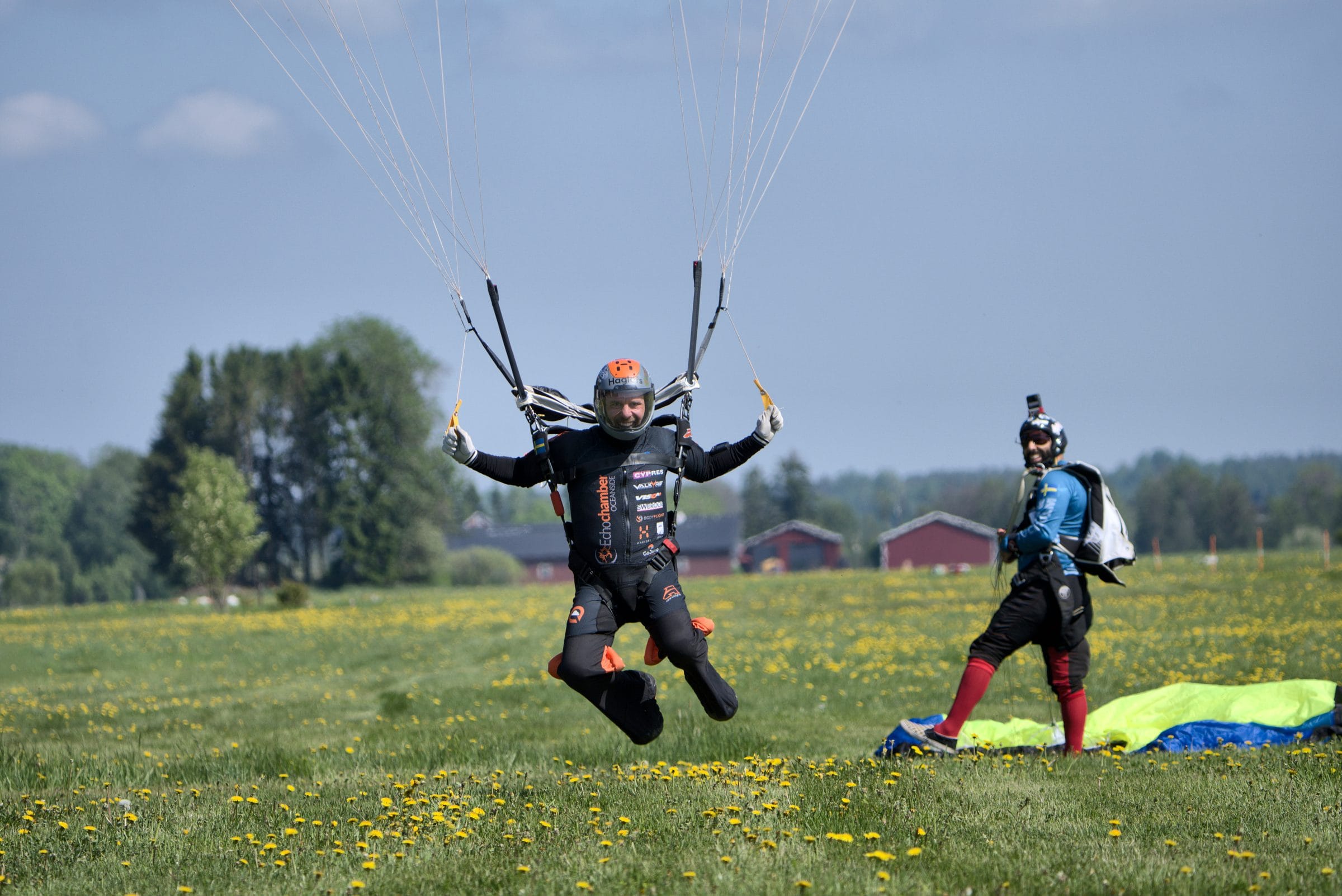
If you are going to worry about something, it is not the parachute failing to open. It is your ankle. The injuries that actually occur in the sport are overwhelmingly landing injuries: sprains, twists and, in rare cases, fractures in a foot or leg. That holds for tandem too, where the landing is the only part of the jump in which your own body does something active.
This is why the ground training before the jump is not a formality. It is almost entirely about two things: body position at the exit, and how you lift your legs for the landing. Do what your instructor tells you during those seconds and the landing is normally soft — most people land sitting down on the grass.
What happens if the parachute does not open?
This is the most common fear and simultaneously the most misdirected one. Modern skydiving equipment has two separate parachutes: a main canopy and a reserve. The reserve is used only if there is a problem with the main, and it is packed by a certified rigger under specific rules.
On top of that, every one of our rigs carries an electronic automatic activation device — a small computer continuously reading altitude and speed. If the descent rate is too high at too low an altitude, it deploys the reserve automatically, regardless of what any human does or fails to do. The Swedish Parachute Association states that the device deploys the reserve at around 225 metres under certain conditions. Read more about the parachutes and equipment.
In other words: “the parachute not opening” is not a single point where everything rests on luck. There are three layers — main, reserve and automation — plus an instructor whose entire profession is handling the second layer if the first misbehaves.
Who checks that it is done properly?
Skydiving in Sweden is not unregulated. It operates within the Swedish Parachute Association, which issues ratings for instructors, riggers and jump masters and sets the rules clubs follow. Everyone who jumps with us is also insured through the association’s policy with Söderberg & Partners.
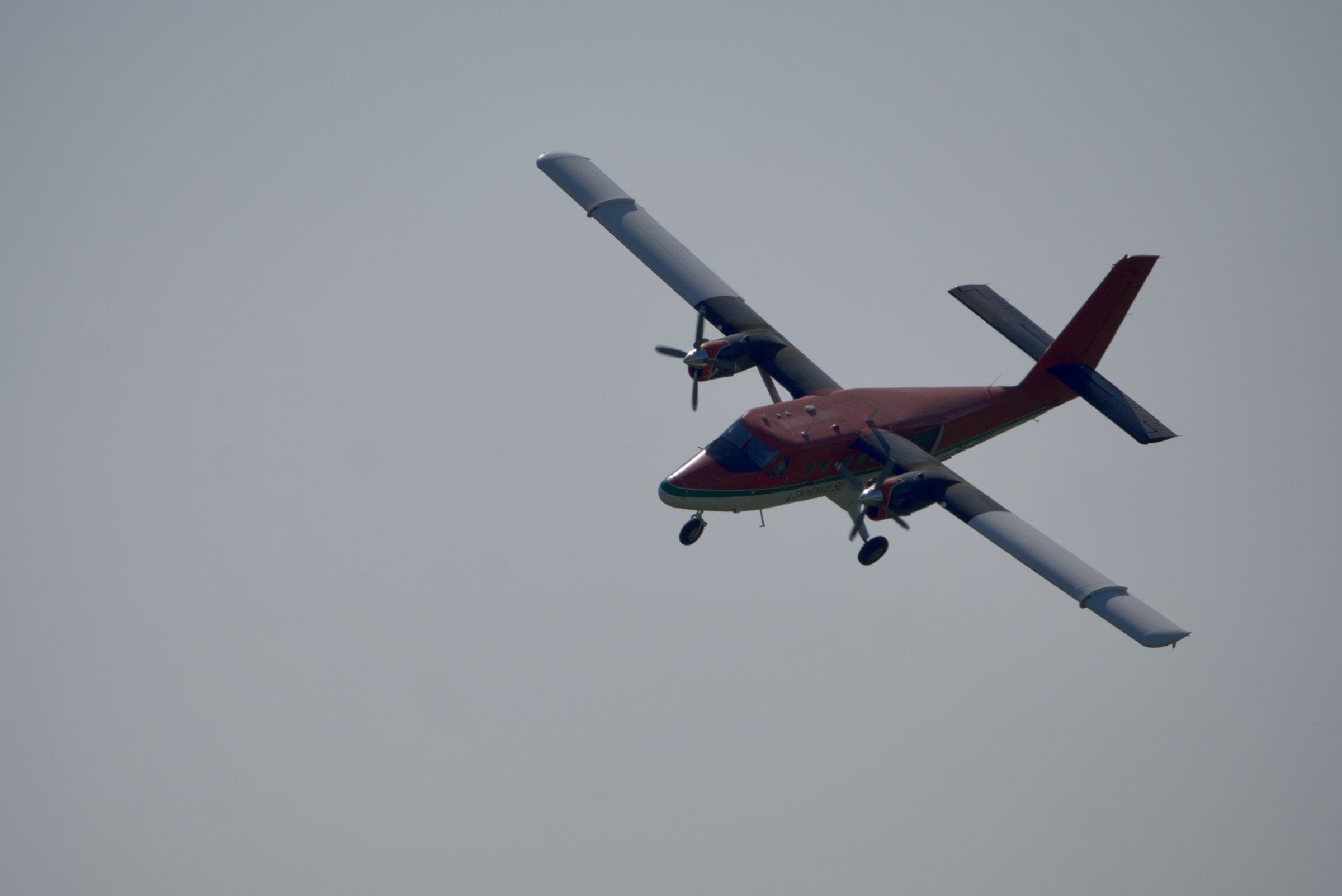
All of our tandem instructors have many years in the sport and thousands of jumps behind them. Skydive Stockholm has been jumping since 1958, and we are the only skydiving club in Sweden flying a twin-engine jump aircraft — a DHC-6 Twin Otter.
Why we cancel in bad weather
This is in practice the most concrete safety measure you will notice, and it is rarely experienced as one: we cancel jumping as soon as conditions are not good. Rain, cloud that is too low, or too much wind — then we do not fly.
The wind limits are set and published. Surface wind may not exceed 8 m/s during a jumper’s first 25 jumps and 11 m/s for other jumping. The jump master and load master always decide whether a lift goes, and they say no often. See weather and wind limits.
A cancelled jump is the system working
Having your day cancelled is frustrating — but it is exactly what you want a skydiving club to do. You can rebook freely or have your money back. Read more about season and weather.
How does it compare to other adventures?
Many people expect a tandem skydive to be the scariest thing they have ever done, and are surprised. At 4,000 metres there are no reference points to the ground — it is more like looking at a map than standing on a tall balcony. Everyday fear of heights often is not triggered at all. Bungee jumping, where you watch the ground the whole way down, strikes many people as more unpleasant despite a far shorter fall.
We have written comparisons against wind tunnels and several other adventures in our guides, if you are weighing up the alternatives.
Summary
A tandem skydive is not risk-free, and we will never write that it is. But the risk is small, it is well mapped, and it lies mostly in things you as a passenger do not control and that your instructor has practised across thousands of jumps. The most common actual injury is a sprained ankle on landing, and what most affects that is whether you lift your legs when told to.
If your hesitation is more emotional than statistical — which it usually is — read on in scared of skydiving.
Common questions about safety
Is tandem skydiving safe?
Skydiving always involves some risk, but tandem skydiving is designed to minimise it, and a tandem jump with an experienced instructor and modern equipment is by far the safest way to try skydiving. In Sweden, there has never been a single fatality in tandem skydiving.
What happens if the main canopy malfunctions?
The instructor cuts away the main and deploys the reserve. It is a procedure every tandem instructor trains on regularly. Beyond that, an automatic activation device deploys the reserve if the descent rate is too high at too low an altitude.
Can you breathe in freefall?
Yes, without difficulty. Many people are so full of adrenaline in the door that they simply forget to breathe — which is a different thing from being unable to.
Am I insured?
Yes. Everyone who jumps with us is insured through the Swedish Parachute Association‘s policy with Söderberg & Partners.
How high do you jump from, and how long do you fall?
The exit is at 4,000 metres. Freefall lasts about 50–60 seconds, the canopy is deployed at 1,700 metres, and 5–10 minutes under canopy follow before landing.
How fast do you fall?
On a tandem skydive you normally reach around 200 km/h in freefall.
Does my own fitness affect safety?
Only marginally, but weight and height matter for the equipment to fit and be loaded correctly — which is why the limits exist. See requirements for a tandem skydive.
What is the most common injury?
Landing injuries, above all sprained ankles. That is why the ground training focuses on lifting your legs for the landing.
More guides
Guide
Scared of skydiving?
Where the fear comes from, when it peaks and what actually helps.
Guide
Requirements for a tandem skydive
Weight, height, age and health — and why the limits are what they are.
Book your tandem skydive
Book your tandem skydive, or read on through our frequently asked questions.