



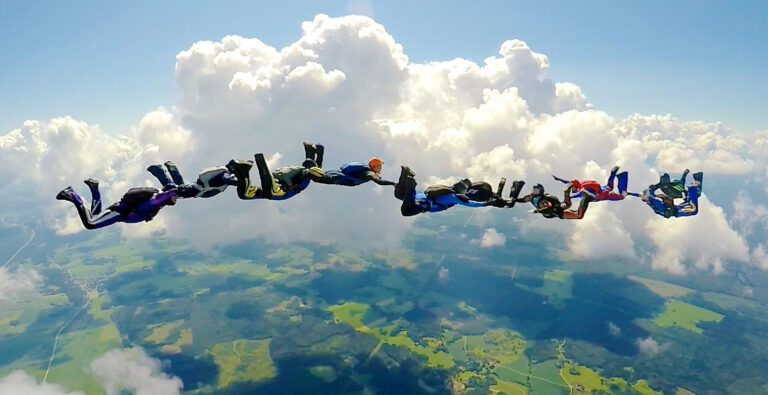
Tandem skydive vs wind tunnel
A wind tunnel and a tandem skydive are often described as the same thing — but only one of them involves leaving an aircraft at 4,000 metres. Here are the differences that actually matter when you are choosing.
Short answer
Do you want to feel the air carry you, practise body position and be able to do it in the middle of winter at an hour’s notice? Choose the wind tunnel. Do you want the flight, the exit, the view over Uppland and a canopy ride down — and a memory you will still be telling people about in thirty years? Choose the tandem skydive. They are not competitors; they complement each other.
In a wind tunnel the air blows upwards at roughly the same speed as you fall downwards on a skydive. The aerodynamics are therefore almost identical: you lie on your belly in an airflow of around 200 km/h and feel exactly how much a small movement of one hand affects your body.
What the tunnel cannot give you is the altitude. There is no aircraft, no door to step out of, no horizon fifty kilometres away and no parachute deploying above you. For many people it is precisely those parts that make a tandem skydive unforgettable.
How they differ
| Tandem skydive | Wind tunnel | |
|---|---|---|
| Altitude | 4,000 metres | Ground level, indoors |
| Freefall | About 50–60 seconds in one go | Flights of 60 seconds at a time, usually 2 per person |
| Speed | About 200 km/h downwards | The airflow is around 200 km/h — you stay still in it |
| After the freefall | A 5–10 minute canopy flight and a landing on grass | You step out of the tunnel and the next person flies |
| The view | Uppland, Lake Mälaren and all the way to Stockholm on clear days | The tunnel’s glass wall and the spectators outside |
| Instructor | You are harnessed to a tandem instructor | An instructor flies in the tunnel beside you |
| Weather and season | Season from late April to early October, weather dependent | All year round, completely independent of the weather |
| Time on site | About 2 hours | About 1–1.5 hours |
| Price | From SEK 2,790 | From about SEK 500–700 per session |
| Age limit | From age 12 with a guardian’s consent, no upper limit | Children can fly from a young age — varies by venue |
| Weight limit | Maximum 105 kg (SEK 300 supplement over 95 kg) | Varies by venue |
The tandem skydive figures apply to Skydive Stockholm in Gryttjom. The figures for the other activity are taken from the operators’ own pages in July 2026 and vary between venues — always check current prices and conditions with the operator.
Which suits you?
Choose a tandem skydive if you want to…
✓ experience real altitude and see the landscape below you
✓ have the whole sequence: the flight, the exit, freefall and canopy flight
✓ be able to say you have made a skydive
✓ give away a gift experience with real weight to it
Choose the wind tunnel if you want to…
✓ try the feeling of freefall without leaving the ground
✓ do it in November, in the rain, at an hour’s notice
✓ practise body position ahead of a skydiving course
✓ bring children who are too young for a tandem skydive
The difference in feeling
A wind tunnel recreates the aerodynamics of freefall almost perfectly. What is missing is the acceleration. On a tandem skydive you go from the aircraft’s speed to around 200 km/h in the first ten seconds, and it is in that transition that the air suddenly feels solid — like lying down on a mattress of wind.
Many people also think the exit gives the same lurching feeling in the stomach as a free-fall ride at a theme park. It actually does not. Because the aircraft has forward speed, the transition into freefall is gentler than most people expect. In the tunnel there is no transition at all — the airflow is already running when you step in.
How much freefall time you get for your money
Counted in seconds, the tunnel is cheaper. Two minutes of flight time in the tunnel is more than double the freefall of a single tandem skydive, for a fraction of the price. But the comparison is unfair, because the tandem price also covers a 15–20 minute flight, a briefing with your instructor, a 5–10 minute canopy flight and the landing.
If you want the jump documented you can add a hand camera or your own freefall photographer — we go through the differences on the page about our video packages.
The wind tunnel as training for skydiving
Here the tunnel is unbeatable. Learning to lie stable, turn and move in a controlled way in the airflow is exactly what a skydiving student needs to be able to do, and in the tunnel an instructor can correct you in real time, run after run, without having to fly up again. Many skydiving students therefore put in a few tunnel minutes before or during their training.
The best of both worlds
Fly in the tunnel over the winter months and book your tandem skydive when the season starts in late April. Want to go all the way and jump on your own? Read about our skydiving course.
Weather, season and planning
The tunnel is weather-independent and can be booked all year round. Skydiving is not: we jump from late April to early October, more or less every day in summer and at weekends in spring and autumn. We send a text message no later than two hours before your arrival time if the weather does not allow jumping, and rebook you free of charge.
If the jump is a present, the gift card is valid for one year, so the recipient can pick their own date. See available slots in our booking calendar.
Frequently asked questions
Does a wind tunnel feel the same as a skydive?
The freefall itself feels surprisingly similar — the airflow and the body position are almost identical. But the altitude, the exit from the aircraft, the view and the canopy flight only exist on a real jump.
Do I need to fly in a wind tunnel before doing a tandem skydive?
No. Tandem skydiving requires no previous experience at all. You get the briefing you need on site, and your instructor handles everything technical.
Which is safest?
A wind tunnel naturally involves fewer risk factors because you never leave the ground. Skydiving always carries some risk, but tandem skydiving is designed to minimise it: experienced instructors, two parachutes and an electronic automatic activation device (AAD) in every rig.
Can you do both on the same day?
Not practically — the wind tunnels are in the city and our dropzone is in Gryttjom, about 1.5 hours from Stockholm and 40 minutes from Uppsala. Put them on separate days.
You will find more answers in our tandem skydiving FAQ.
Read on
Zipline & high ropes
Tandem skydive vs zipline and high ropes
A good-value half day in the forest for the whole family, or a once-in-a-lifetime experience from 4,000 metres? How to choose — and how to combine them.
Bungee jumping
Tandem skydive vs bungee jumping
Two seconds on a rubber cord, or fifty seconds of freefall? On height, recoil, fear and what you can actually book in Sweden.
Paragliding
Tandem skydive vs paragliding
Freefall or a long, quiet flight? The differences between a tandem skydive and paragliding in altitude, time in the air, weather dependence and where each can take you in the sport.
Book your tandem skydive
Book your tandem skydive today, or give away a gift card nobody forgets.