




DZ rules
Local rules for Gryttjom and the Swedish regulations (SBF) — gear, camera, wingsuit, aircraft routines and tracking.
Local and Swedish rules
You jump under the Swedish regulations (SBF) from the Swedish Parachute Association plus our own local rules for Gryttjom. The complete set of local rules is posted on the wall beside the manifest, and the jump leader or an instructor will brief you when you check in. The essentials are below.
General gear
- Helmet, AAD, hook knife and altimeter must always be worn on every jump.
- An audible altimeter is required on wingsuit, camera and freefly jumps.
- A jumpsuit must be worn by A-licence holders.
Jumping with a camera
- You need a C-licence or equivalent to jump with a camera.
- Your camera must be either snag-free or fitted with a cutaway system.
- The jump leader inspects your camera mounts when you check in.
Wingsuit
- 300 jumps and a C-licence or equivalent are required to fly a wingsuit. There is no limit for tracksuits.
- Beginner: 0–50 wingsuit jumps.
- Intermediate: 51–200 wingsuit jumps.
- Advanced: more than 200 wingsuit jumps, of which 100 must be in an intermediate suit.
Angle & tracking jumps
- Tracking and angle jumps have their own requirements for leaders, group sizes and jump numbers.
- Read the tracking rules further down this page before you plan such a jump.
Inside the aircraft
- Seatbelt and helmet must be worn from the moment the aircraft starts moving until an altitude of 500 metres (1,500 ft).
Local rules
- All local rules for Gryttjom are posted on the wall beside the manifest.
- The swoop pond may only be flown from a low pass, and first-timers need a briefing with a local swooper.
Tracking rules
Tracking is defined as: ”Deliberate horizontal movement during the jump (flat tracking, angle jumps, atmonauti and so on).”
To be approved as a tracker (TK) you must understand the local tracking rules and have passed the online tracking test.
Requirements for jumps
- On solo jumps, the plan for the jump must be approved by the load master.
- For group jumps the leader must be an approved tracking leader (TKL) or Advanced Tracking Leader (ATL). Everyone in the group must also meet the jump requirements below.
- For 2-ways and 3-ways the leader must be an approved tracking leader. All jumpers must also have at least 50 jumps after completing their training and be approved trackers in SkyWin. Exceptions to the jump minimum can be made for one-on-one coaching.
- For 4-ways and 5-ways, everyone in the group must in addition have at least 50 tracking jumps.
Tracking leader (TKL)
To be approved as a tracking leader (TKL) you must have at least 10 tracking jumps, have read the Tracking Compendium by Rune Aspvik (in Swedish), and have passed the online tracking leader test.
- A tracking leader with fewer than 50 tracking jumps may only lead a 2-way or 3-way.
- A tracking leader with more than 50 tracking jumps may also lead 4-ways and 5-ways.
- Tracking groups larger than 5-ways may only be led by an ATL.
To become an Advanced Tracking Leader you must be an approved TKL and be approved as an ATL by the Chief Instructor.
The tracking leader’s responsibilities
- Confirm that all jumpers in the group are approved trackers in SkyWin and meet the requirements for the size of the group.
- Keep track of the line of flight, wind direction and strength at different altitudes, and know what the other tracking groups on the load are planning.
- Navigate the group well clear of the line of flight and make sure the break-off happens in a safe place and a safe direction, away from the line of flight.
- Navigate so that every jumper in the group has a good margin to make it back to the dropzone.
- Adapt speed and difficulty to the least experienced jumper in the group.
Local tracking rules
Every tracking jump must have a plan covering: the exit, direction, any turns and the break-off, plus a plan B in case the jump cannot be flown because of clouds or anything else.
Normally there is a maximum of 2 tracking groups per pass. To have 3–4 tracking groups on one pass, one of the groups must be led by an ATL who approves every group’s plan. A briefing with all the group leaders must be held, and the flight direction and opening area must be drawn on the tracking map at the manifest. The jump leader must be informed.
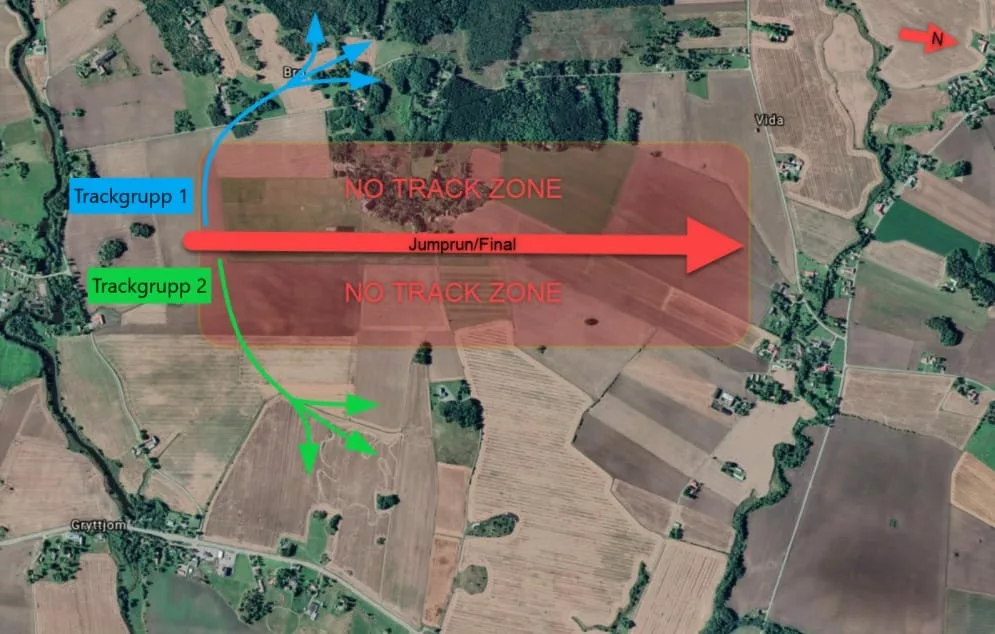
Example tracking pattern
Example tracking pattern with a northerly jump run: track away from the jump run and avoid the area where vertical groups open their canopies (the no-track zone). After the break-off, keep flying your canopy straight for about 5 seconds after opening before navigating back to the landing area.
Ready to become an approved tracker?
The tracking test is taken online — a pass is registered in SkyWin.
Questions about the tracking rules? Talk to the jump leader on site or contact styrelse@skydive.se. « Back to DZ Info