




Scared of skydiving?
Almost everyone is nervous. Here is what the fear consists of, when it peaks, and what actually helps — including what happens if you change your mind in the aircraft.
If you are scared of skydiving, you are not an exception. You are the normal case. Almost everyone who comes to us is nervous, and that includes plenty of us who have been jumping for twenty years. Believe it or not, there are experienced skydivers who are afraid of both heights and flying.
This guide is not about talking you out of your fear. It is about describing what actually happens, in what order, so that fewer things come as a surprise. Fear of the unknown shrinks when the unknown becomes known.
Three kinds of fear
What gets called “scared of skydiving” is usually three separate things, and they have different answers.
Fear of heights
This one is often triggered surprisingly little. A fear of heights depends on reference points — you feel it in your body precisely because you can see how far down it is relative to the building, ladder or balcony rail you are standing on. At 4,000 metres there are no such reference points. The ground becomes a pattern, and most people describe it as looking at a map rather than looking down.
Fear that the equipment will fail
This is the only one of the three that responds to facts, and the facts exist: two separate parachutes, an automatic activation device and an instructor with thousands of jumps. We have gone through the whole picture with numbers in is skydiving dangerous. If this is your fear, read that guide — it was written for you.
Fear of losing control
The hardest one, and the one statistics do not help with. Here is the honest answer: you do not have control. Your instructor does. For some people that is precisely the problem, and for many others it is exactly what makes the jump possible — you do not need to know anything, remember anything or perform anything.
How the day works
Nerves are not a steady curve. They have a clear peak, and it arrives later and lasts shorter than people expect.
The journey here and the wait. Mentally this is often the worst part, because you have time to think. Having someone with you helps.
The ground training. You meet your instructor and go through body position at the exit and how to lift your legs for the landing. Almost everyone feels calmer after this — it becomes concrete, and you notice that the person you are about to be attached to has done it thousands of times.
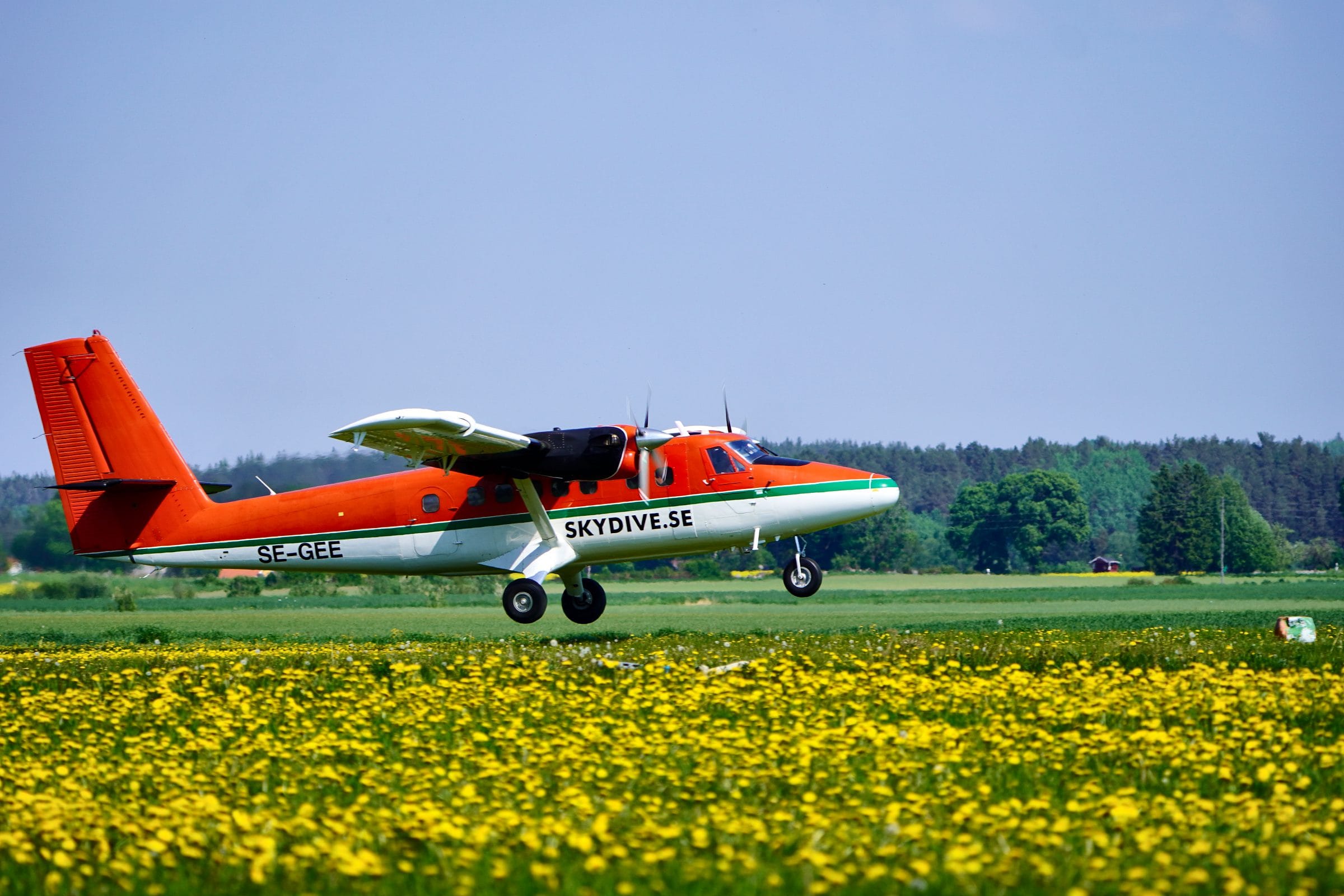
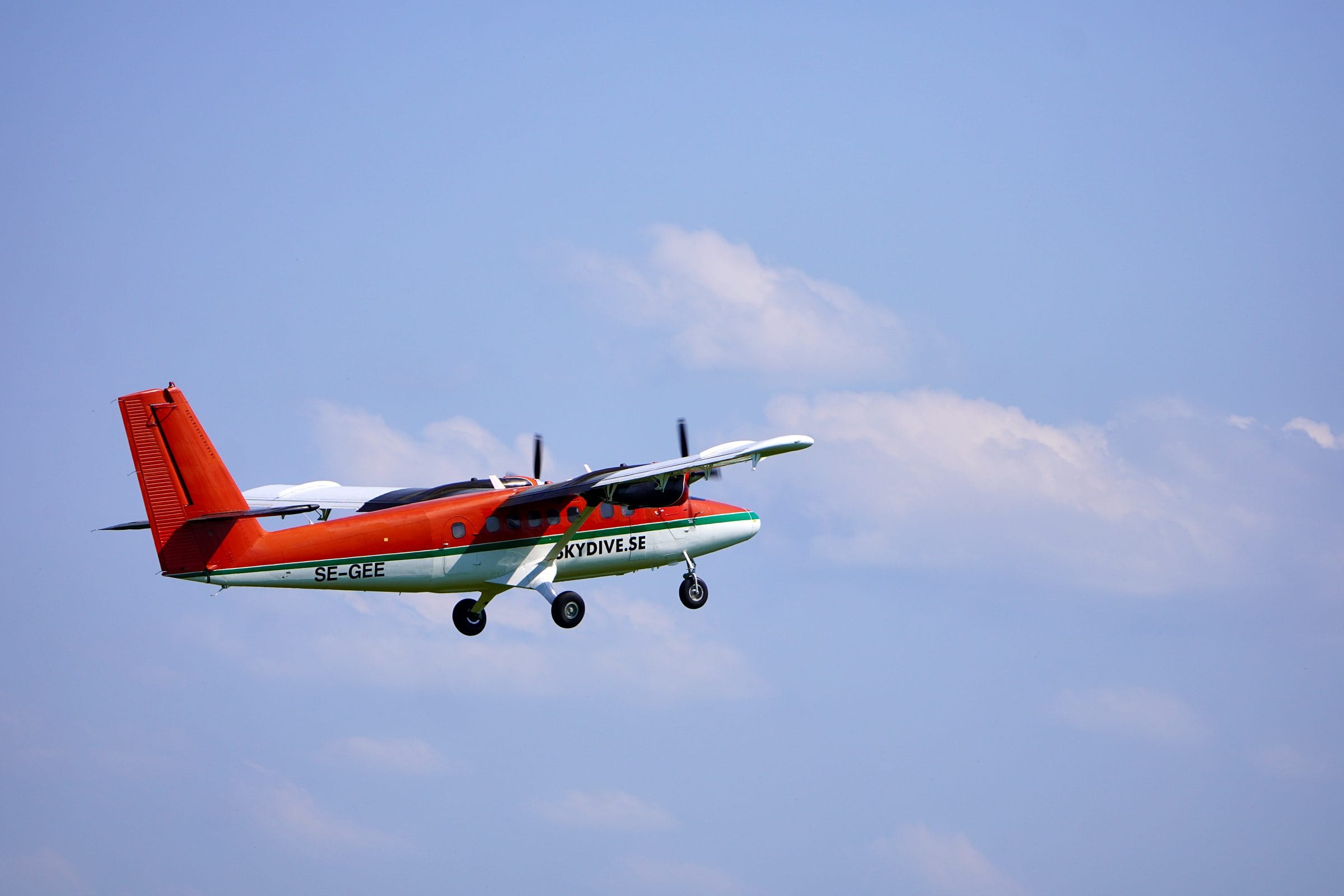
The climb. Roughly 15–20 minutes. The mood in the aircraft is usually surprisingly light; the experienced jumpers joke around and it is contagious. This is where you and your instructor tighten the harness properly.
The door. This is the peak. The door opens, the air comes in, and in those seconds almost everyone thinks “what am I doing here”. It lasts exactly that long: seconds. You do not have to jump yourself — the instructor initiates the exit, and it happens quickly.
Freefall. Here something happens that is hard to prepare people for: the fear goes away. Because of the aircraft’s forward speed the exit is a gradual transition rather than a stomach-drop, and there is none of the lift-shaft sensation many people expect. About 50–60 seconds, around 200 km/h, mostly noise and wind.
Under canopy. The canopy is deployed at 1,700 metres and everything goes quiet. Five to ten minutes of views across Uppland, and this is the part people remember most fondly afterwards.
The landing. You lift your legs, the instructor puts you down, usually sitting on the grass. Then you walk away with an entirely new sense of what you are capable of.
About breathing
You can breathe perfectly well in freefall. Many people are so full of adrenaline in the door that they forget to — which is a different thing. If you notice you are holding your breath: breathe out.
Seven things that help
- Tell your instructor you are scared. This is the single most effective thing. They have heard it a thousand times and will adjust how they talk to you all the way up.
- Bring somebody. Either as a fellow jumper or as an audience at the landing area. The wait is easier in company.
- Book early in the day. The longer you wait, the more time you have to build it up in your head.
- Eat normally. Not on an empty stomach, not a large meal right before. Drink water if it is warm.
- Jump sober — and rested. Alcohol is not permitted before a jump, and a hangover makes nerves much worse.
- Order a photographer or hand camera. Sounds counterintuitive, but it gives you a job: look at the camera and smile. Having a job is surprisingly calming.
- Read through what is going to happen. The day of your skydive, step by step, removes a large part of the unknown.
What if I change my mind?
We never force anyone to jump. That sentence is worth reading twice, because it is the whole answer.
In practice it is very unusual for somebody to back out once they are in the aircraft. Most people feel considerably safer after meeting their instructor and going through the ground training. If you do hesitate in the door, the pilot can usually fly another circuit and give you a second chance. And if you land with the aircraft instead — that happens, and nobody on the airfield will make a thing of it.
If you are unsure whether to book at all, consider a gift card instead. It is valid for a year, is not personal and can be transferred, so the decision is not locked to a date.
Finally
Very few of our customers regret doing it afterwards. For many people, overcoming their own fear is the real reason to jump — the freefall is almost a bonus. It is also why it is so common for people to come back, and why some of them eventually take our skydiving course.
Common questions about nerves
I am afraid of heights — can I still jump?
Yes, and many people who are afraid of heights do. At 4,000 metres you have no natural reference points to the ground, so a fear of heights often is not triggered at all. Even experienced skydivers can be afraid of heights.
What if I do not dare to jump once I am in the aircraft?
We never force anyone. Usually the pilot can fly another circuit and give you a second chance, and landing with the aircraft is possible.
Do I have to jump out of the aircraft myself?
No. The instructor initiates the exit — you do not have to make the decision in the door.
Does it feel like the stomach drop on a rollercoaster?
No, and this is one of the most common misconceptions. The aircraft’s forward speed makes the exit a gradual transition, so that lift-shaft feeling in your stomach does not happen.
Could I faint?
It is very unusual. If you have a history of fainting, dizziness or other disturbances of consciousness, it is covered in our health and liability declaration — answering yes to a health question means a short conversation, not an automatic no.
Would a drink beforehand help?
No, and it is not permitted. You must be sober to jump.
Can I wear glasses?
Yes. We have goggles that fit over glasses. Contact lenses work fine too.
Is it easier if I jump with a friend?
For most people, yes. If you book the same arrival time you normally go up in the aircraft together and jump from the same lift.
More guides
Guide
Is skydiving dangerous?
The numbers, the safety nets in the equipment and what actually causes injuries.
Tandem skydiving
The day of your skydive
The whole day step by step, from booking to landing.
Book your tandem skydive
Book your jump — or take a gift card and decide the date later.