




Tandem skydive vs paragliding
Paragliding and skydiving look the same in a photo — a wing, a person in a harness. But one is built on freefall and the other on never falling at all. Here are the differences.
Short answer
Paragliding is about flying: you are under a wing from the first second and can stay up for a long time when the thermals allow. A tandem skydive is about the freefall: 4,000 metres, about 50 seconds at 200 km/h, and then a canopy flight down. If you want to feel freefall, the tandem skydive is the only one of the two that offers it.
In paragliding you launch from a slope, a mountain or by winch, and the wing is already open and flying from the outset. There is never any freefall. Updraughts and thermals can carry you higher than your launch point, and skilled pilots fly both long and far.
A tandem skydive works the other way round: up by aircraft to 4,000 metres, out through the door, about 50 seconds of freefall, and only at 1,700 metres does the canopy deploy. The canopy flight down takes 5–10 minutes — roughly as long as a shorter tandem paraglider flight, but after a completely different opening.
How they differ
| Tandem skydive | Paragliding (tandem) | |
|---|---|---|
| Freefall | About 50–60 seconds | None — you are flying under the wing the whole time |
| Altitude | 4,000 metres | Usually a few hundred metres above the launch point, more in good thermals |
| Time in the air | A 15–20 min flight up, about 50 sec of freefall, 5–10 min under canopy | Typically 15–30 minutes, longer in good conditions |
| Launch | An exit from a Twin Otter | A running launch from a hill or slope, or a winch launch |
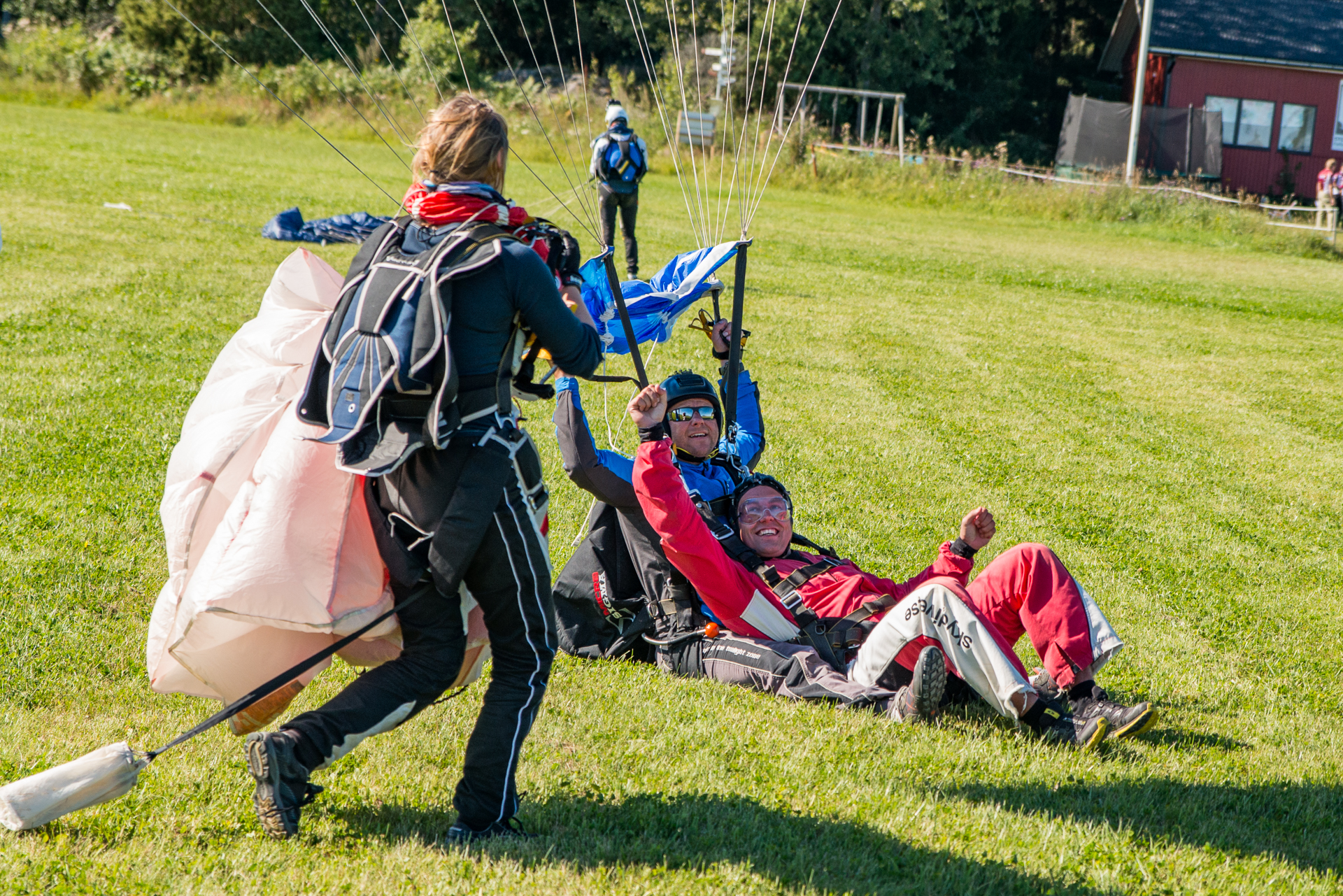
| Landing | A soft landing on grass, often sitting down | On your feet, with a few steps |
| Speed | About 200 km/h in freefall | Typically 25–40 km/h in flight |
| Weather dependence | Needs reasonable wind and sufficient visibility | Very weather dependent — wind direction, strength and thermals all have to line up |
| How easy it is to book | Fixed slots in the booking calendar, with a text message no later than 2 hours before | Often a provisional booking where the operator calls when the weather allows |
| Price | From SEK 2,790 | A tandem flight from about SEK 2,500 |
| Going solo | An AFF course at SEK 14,490, an A licence after 25 jumps | A beginner course from about SEK 6,000, certification via SSFF |
| Age limit | From age 12 with a guardian’s consent | Varies by operator |
The tandem skydive figures apply to Skydive Stockholm in Gryttjom. The figures for the other activity are taken from the operators’ own pages in July 2026 and vary between venues — always check current prices and conditions with the operator.
Which suits you?
Choose a tandem skydive if you want to…
✓ experience freefall — paragliding does not offer it
✓ have a fixed date and a time to keep
✓ get up to 4,000 metres by aircraft
✓ be able to add film and photos of the jump itself
Choose paragliding if you want to…
✓ be in the air for a long time, quietly, with no noise
✓ fly close to the terrain and see the landscape up close
✓ have a calmer experience without high speed
✓ learn to fly a wing rather than to jump
Freefall or flying
Everything else is detail by comparison. Paragliding gives you a wing from the start and a calm, almost silent flight. A tandem skydive gives you 50 seconds where nothing is carrying you, the speed is around 200 km/h and the wind roars. They are two distinct sensations, and they often appeal to different people.
If you have already flown a paraglider and missed the intensity, a tandem skydive is the next step. If you have done a tandem skydive and liked the quiet canopy flight best, paragliding is worth a try.
Weather and season
Paragliding requires the wind to come from the right direction at the right strength for that particular launch site, plus workable thermal conditions. That is why tandem flights are often booked loosely, with confirmation the same morning or later.
Skydiving is also weather dependent, but more predictably plannable. You book a slot in our booking calendar, and no later than two hours before arrival you get a text message telling you whether jumping is going ahead. If it is cancelled we rebook you free of charge. Our season runs from late April to early October.
Want to take the sport further?
Both sports are organised with training, certification and insurance. Paragliding is run by the Swedish Paragliding Federation (SSFF), where a beginner course starts at around SEK 6,000 and the cost rises with equipment and further steps.
Skydiving goes via an AFF course. With us it costs SEK 14,490 and includes three days of theory, four days of jumping, seven instructor jumps, membership, insurance, the course book, equipment loan and accommodation. After 25 passed jumps you hold an A licence valid worldwide. Read more about the skydiving course.
Freefall is not a prerequisite for flying a paraglider
And the reverse does not apply either: you never need to have flown a paraglider to do a tandem skydive. Tandem skydiving requires zero previous experience — you get all the instruction you need on site.
Frequently asked questions
Is paragliding the same thing as skydiving?
No. In paragliding you launch with an open wing and fly straight away, with no freefall. In skydiving you jump from an aircraft, fall freely and only deploy the canopy at lower altitude.
Which is cheapest to try?
They are close: a tandem paraglider flight starts at around SEK 2,500 and a tandem skydive with us at SEK 2,790.
Which is easiest to book?
The tandem skydive. You book a fixed slot and get confirmation no later than two hours before. Paragliding depends more on the right wind at the right place, which often means rescheduled times.
Do you see as much on a tandem skydive?
From 4,000 metres you see considerably further — on clear days all the way to Stockholm. Paragliding instead gives you closeness to the terrain and more time to look.
You will find more answers in our tandem skydiving FAQ.
Read on
Wind tunnel
Tandem skydive vs wind tunnel
The feeling of freefall indoors all year round, or the whole experience from 4,000 metres? Here is how 60 seconds in the tunnel differs from 50 seconds of real freefall.
Zipline & high ropes
Tandem skydive vs zipline and high ropes
A good-value half day in the forest for the whole family, or a once-in-a-lifetime experience from 4,000 metres? How to choose — and how to combine them.
Bungee jumping
Tandem skydive vs bungee jumping
Two seconds on a rubber cord, or fifty seconds of freefall? On height, recoil, fear and what you can actually book in Sweden.
Book your tandem skydive
Book your tandem skydive today, or give away a gift card nobody forgets.