Local Rules for Tracking
Tracking means: Horizontal movement during the jump (flattrack, angle jump, atmonauti, etc.).
To be approved as a tracker (TK), you must have completed the online tracking-test at the bottom of this page.
For solo jumps, the jump plan must be approved by the load master.
For group jumps, the leader must be an approved Tracking Leader (TKL) or Advanced Tracking Leader (ATL). All jumpers in the group need to fulfill the jump limits below.
For 2-ways and 3-ways, the leader must be an approved tracking leader. All jumpers must have at least 50 jumps after training and be approved trackers in SkyWin. An exception can be made to the jump number requirement for one-on-one coaching.
For 4-ways or 5-ways, all jumpers must have done at least 50 tracking jumps.
To be approved as a tracking leader (TKL), you must have done at least 10 tracking jumps, and completed the online tracking leader-test at the bottom of this page.
Groups larger thnan 5-way needs to be lead by an ATL.
To be approved as an Advanced Tracking Leader, you must already be a TKL and be approved by our Chief Instructor.
The tracking leader’s responsibilities include:
– Confirm that all jumpers in the group are approved trackers in Skywin and fulfills the jump requirements.
– Being aware of the line of flight, wind direction and wind speed at various altitudes, and the flight plans of other tracking groups on the load.
– Navigating the group well away from the line of flight and ensuring break-off happens at a safe location and in a safe direction (away from the line of flight).
– Navigating so that the entire group can return to the landing area with good margin.
– Adapt the speed and difficulty to the least experienced jumper in the group.
Local tracking rules
All tracking jumps must have a plan that includes: exit, direction, any turns and break-off, as well as a Plan B in case the jump cannot be performed due to clouds or other factors.
Normally, there are a maximum of 2 tracking groups per load.
To have 3 or 4 tracking groups on a load, one of the groups has to be lead by an ATL who approves the plan of each group. A briefing with all group leaders must be carried out, and the flight direction and opening area must be drawn on the tracking map at manifest. The jump leader must be informed.
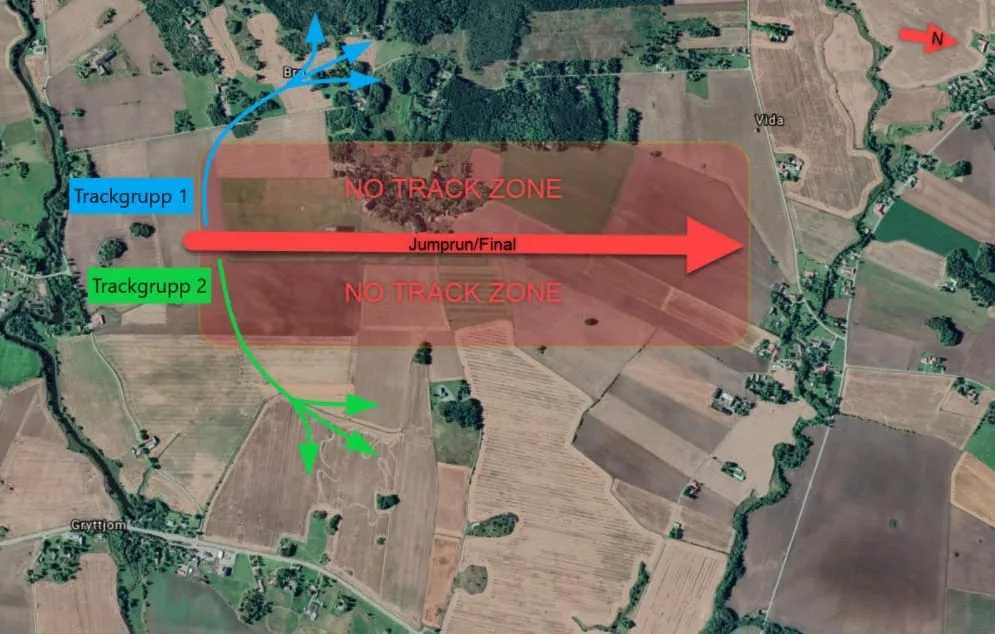
Example of a tracking pattern
Example of a tracking pattern with jump run heading north:
Track away from the jump run and avoid areas where vertical groups deploy their parachutes (no track zone).
After break-off, continue flying your canopy straight for about 5 seconds after deployment before navigating back to the landing area.